

At the Bentley Historical Library, an Active Brand of Learning
This article is the final part of a series exploring cultural collections at the University of Michigan, particularly their role in teaching and civic engagement. Read previous entries about the Clements Library, the U-M Museum of Art, and Matthaei Botanical Gardens and Nichols Arboretum.
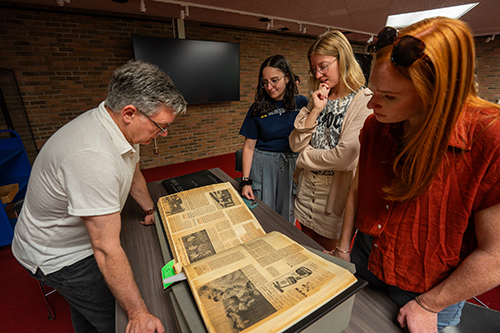
Students research primary sources at the Bentley as part of Professor Mark Clague’s musicology class. Photo by Chris Boyes.
When the Bentley Historical Library’s latest exhibit debuts this week, visitors will experience something greater than its two floors of artifacts, animations, and interactive displays: they will continue a long tradition where U-M students are both learners and active participants in shaping our understanding of the world.
“Fill the Ranks”: The Civil War and the University of Michigan explores how Michigan students sprang to action from some of the first moments of the conflict, organizing companies, practicing military drills, and inspiring local unity toward a greater cause during what would become a transitional period for higher education. Estimates vary, but approximately 1,400 to 1,800 U-M students served over the course of the Civil War, with 110 losing their lives.
Students were heavily involved in the creation of the exhibit, which runs from Sept. 25 to July 2, 2027 at the historic Judy and Stanley Frankel Detroit Observatory, a division of the Bentley. Their active learning around conserving and selecting materials, developing content, visual design, and storytelling all translated to the finished experience that will be on display.
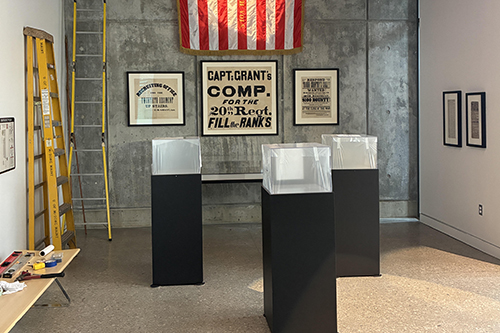
The “Fill in the Ranks” exhibit under construction. Photo courtesy of the Bentley Historical LIbrary.
“We’re training the next generation of archivists and cultural heritage professionals,” said Alexis Antracoli, who has been director of the Bentley since 2023 and served in archiving and preservation roles there earlier in her career. “Whether through processing collections, cataloging materials, or working with digital content, we’re making sure our experiences for students aren’t just another job on campus. Everything they do is a professional development opportunity.”
The library’s staff formed a committee called the Student Engagement and Management Squad to ensure that students know what to expect, the importance of connecting with other staff, and how to engage professionally by attending meetings and mentoring opportunities.
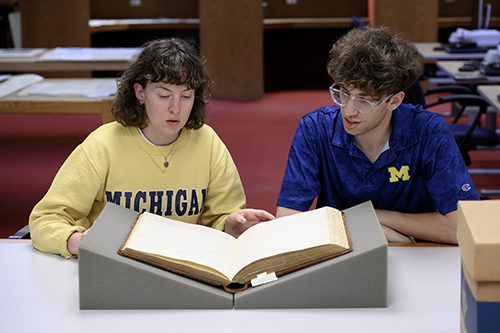
Berkley Sorrells (left) and Jaxson Kaplan-Rudolph (right) interned at the Bentley this past summer, researching and organizing U-M athletics collections. Photo by Lon Horwedel.
For both the students and the teams involved, their work on “Fill the Ranks” aspires to connect with a wider audience.
“It’s really our first attempt to do an exhibit on a major theme and U-M history, and we are aiming for it to have campus-wide impact,” said Antracoli. “We want people to know about our collections, to know about the history of the university and of the state. The observatory gives us a dedicated space that’s closer to Central Campus.”
“It’s a way to showcase our materials, to tell the stories that are in the boxes, and provide an opportunity for people who may never do archival research to engage with some of our collections’ content.”
Thinking Outside the Boxes
The collaborative, hands-on approach of the Bentley extends to faculty and teaching as well, across a broad range of disciplines.
Many methods are familiar: classes and instructors may work with the Bentley on orientation sessions about how to use their archives, assistance with primary source interpretation, or coordinated assignments that send students to the library for research. Their team also partners with faculty to design custom experiences and active learning sessions, where recent, innovative projects have spanned traditional fields like history as well as art, architecture, and education.
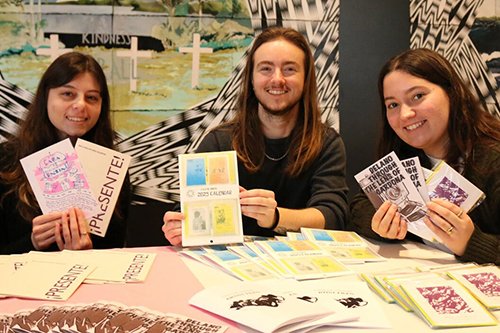
Photo courtesy of UMMA
As a professor at the Stamps School of Art & Design, and artist featured in the UMMA exhibition La Raza Art and Media Collective 1975–Today, Nicole Marroquin designed a zine-making course last year that helped students explore history through hands-on creativity and storytelling with the Bentley.
The course was inspired by the exhibition and celebrated the legacy of La Raza Art and Media Collective, a U-M student organization that amplified Chicano and Latino voices through cultural events, exhibits, and a journal of essays, poetry, and art. Marroquin encouraged her students to dive into this history by exploring the library’s archives, and saw zines as a perfect way for students to engage with the past while creating something new and personal.
A Practice in Empathy
One crucial aspect of the Bentley’s mission, shared as a joint enterprise by all of U-M’s cultural collections, is its commitment to teaching and civic engagement with the communities bordering campus: to bring history to life as a return on the public investments made in the university.
Jeff DeMoss, a Huron High School social studies teacher who was awarded an annual teaching fellowship by the Bentley in April, first visited the library with his 11th grade students for primary research on various topics to support essay work.
“Having the Bentley as a resource is such a privilege,” said Demoss. “Over the last couple years, my students who have visited the Bentley have received world-class help from the archivists, who have done an amazing job helping students. The staff have helped them to think about, research, and discuss the past like real historians.”
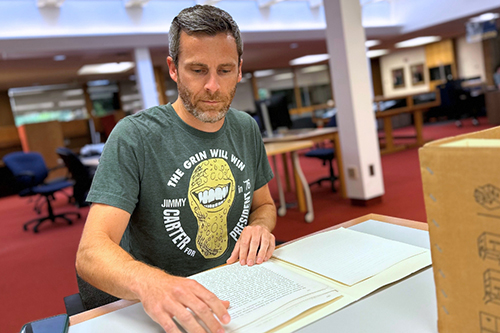
Social studies teacher Jeff DeMoss was awarded an annual teaching fellowship by the Bentley and visited the library to research the history of protest movements in Ann Arbor. Photo by Madeleine Bradford.
In addition to his own upcoming fellowship work, which will explore second-wave feminist protests in Ann Arbor, Demoss also brought students to the library to explore the histories of area schools as part of the city’s bicentennial celebration in 2024.
“History is a practice in empathy,” said Demoss. “By seeing our past, especially our local past, the Bentley helps students, teachers, and our community better understand the world around us. Hopefully that helps us better understand each other in the present and learn some valuable lessons from our rich local history.”
| MORE INFORMATION |