

Everything Has a History: Teaching and Engagement at the Clements Library
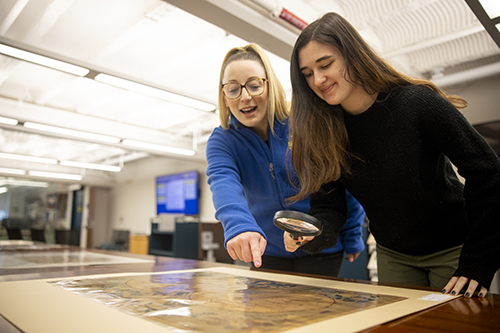
Photo courtesy of Marc-Gregor Campredon, Office of University Development
William L. Clements felt that in order for U-M to be a truly exceptional university, it should be the home of a premier collection of American history and culture in the Midwest.
A U-M engineering alumnus, Clements used a personal fortune built from major engineering projects at the turn of the 20th century to indulge a passion for history and rare books that concentrated on manuscripts from the American Revolution.
Clements graduated in 1882; forty-one years later, the William L. Clements Library opened with the gift of his extraordinary collection: 20,000 volumes of rare books, 2,000 volumes of early newspapers, several hundred maps, and the papers of Lord Shelburne, the British Prime Minister who negotiated the peace ending the Revolutionary War.
“This is the best collection of early Americana on any public university campus in the country,” says Paul Erickson, who has served as the library’s director since 2020. “We collect material that is from a pretty thin slice of human history, but within that narrow span we go really deep.”
“We have items from all possible printed formats, graphics, maps, photographs, about as near as we can get to every possible walk of life from those periods. Our mission is to collect, preserve, and share the printed record of American history and culture.”
Erickson places special emphasis on the share part of the library’s mission, and is quick to highlight its proactive role in engaging and educating the broader community beyond U-M. In addition to providing free digital access to the library’s resources, the library also makes many collections and artifacts available to the public through in-person guided tours and regular open hours for exhibit browsing.
“The Clements is one of the most beautiful buildings on campus, and anyone can use it — undergraduates, graduate students, faculty. But you don’t have to be connected to the university,” Erickson explains.
“I talk to alumni all the time, and I ask how many of them visited the Clements, and maybe 25% did. The rest thought they weren’t allowed in.”
In his role as director, Erickson has worked hard to encourage the campus community to explore the collections.
“We exist for everyone to come and research, so people should know that they’re welcome to visit us.”
To Collect, Preserve, and Share
As students visiting the Clements Library know, there’s no substitute for physically interacting with history.
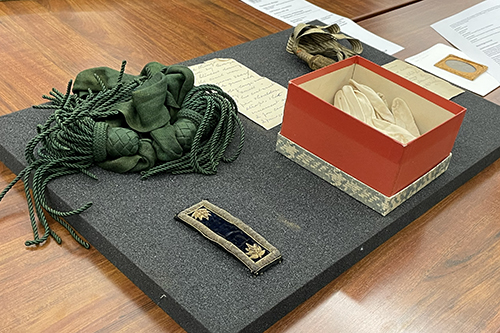
Displayed as hands-on, primary research sources for a recent class, Civil War-era objects from everyday life – realia, in the language of library curators – carry weight far beyond the material: A blanket, well-worn and rough to the touch but surprisingly durable, evokes as much about the journey as the traveler. A dark green surgeon’s sash, white cotton gloves, blue shoulder strap, and golden hat ornament offer vivid yet ominous reminders of who carried status and responsibility in a Union Army encampment. A noisemaker used aboard 19th-century ships is still loud enough to cut through the roar of storms and crashing waves. These are but a few of the hundreds of thousands of items collected in the 102-year history of the library, with the potential to spark immersive teaching and learning when they are connected with the courses and curricula.
Closer, more tactile observation reveals an object’s story, and inspires deeper critical thinking, in ways not possible when we view it through a screen. In our highly digital world, faculty, students, and community members alike, spanning a wide range of disciplines, benefit from investing the time and patience needed to handle artifacts and learn from them most deeply.
Into the Past
Since 2000, the process of library curation and the experience of browsing its materials have evolved in parallel with the wave of digitization. That evolution has been distinct at the Clements in recent years, as its staff work more hand-in-hand with faculty.
Early in his tenure as director, Erickson created a new position to address that need. In 2021, Maggie Vanderford was hired as the Clements’s inaugural librarian for instruction and engagement, providing a dedicated channel to help coordinate teaching across more diverse disciplines and oversee the fellowship program for visiting researchers.
LaKisha Simmons, associate professor of history and women’s and gender studies in LSA, engaged with the library this semester for a class focused on “contraband camps” during the Civil War. The U.S. Congress decided in 1861 that people who escaped slavery across Union Army lines would no longer be returned, and instead be classified as “contraband of war,” or captured enemy property. By the end of the war, more than 250 of these refugee camps were operating in the South.
In developing her course — which features intimate analysis of primary source documents including images, letters, memoirs, reports, and newspapers of the period — Simmons had active partners in the library’s team of curators, who are now more closely involved with instruction. They collaborate directly with faculty to help create lesson plans, curricula, and bring students in for hands-on interaction with carefully selected materials.
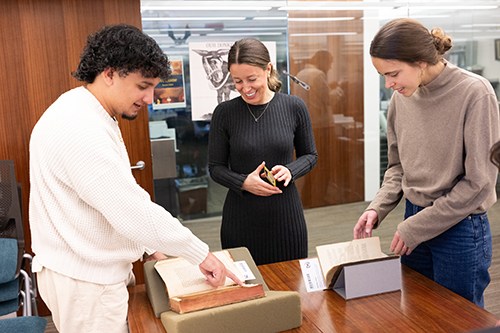
Photo courtesy of Dieu-Nalio Chery, Michigan Photography
“I really enjoy working with folks at the Clements because they have both archival and academic expertise,” says Simmons. “They are really helpful not only for discussing source material, but also the process of writing and telling stories.”
“When you hold an actual letter in your hand, like a letter of introduction a fugitive enslaved person would have held when traveling the Underground Railroad, it transports you from the present into the past.”
| ၊၊||၊ LISTEN TO MORE |
 “Bloody Work: Lexington and Concord 1775” “Bloody Work: Lexington and Concord 1775”Paul Erickson, director of the Clements Library, talks about one of his favorite exhibits since joining U-M in 2020. |
Everything Has a History
After poring over the collected artifacts, Simmons’ students connect the symbolism of the various pieces with present-day questions in medicine, law, and several other fields. While the library’s classes often come from familiar areas including history and English, this group’s insights underscore its teaching value and relevance for a full range of fields.
“One reason this class works so well is because the Clements is a premier institution for research. Scholars come from all over to develop their book projects,” adds Simmons. “So it is wonderful for our undergraduate students to have an advanced research experience, the same as if they were graduate students or professional scholars.”
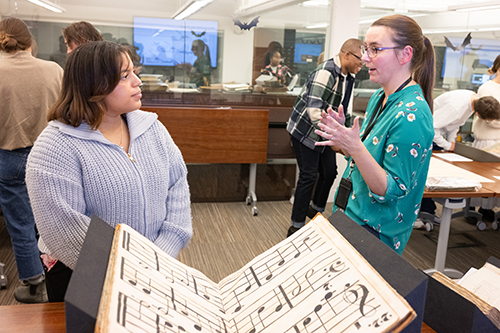
Photo courtesy of Dieu-Nalio Chery, Michigan Photography
The Civil War, for example, created unprecedented demand, manufacturing, and marketing for prosthetic limbs – and a world of tangible, relevant lessons for today’s disability studies students. The same era prompted composers to create piano music that could be played with one hand. Thousands of the Clements’s images trace the roots of modern science, engineering, and architecture to transportation infrastructure in the early United States. 19th-century exercise manuals and historical writings about physical fitness and sports are tailor-made for the School of Kinesiology.
“Everything has a history,” says Erickson. “Our aspiration is to build a collection that can shed light on any question an instructor might want to ask, no matter what field they’re in.”
“Obviously, with the period covered by our collection, the assumption is we may not appeal to the computer sciences. But we do have material on computation machines from the 1800s. If instructors want to engage their students with how their field got to where it is today, and how it evolved over time, we’d love to partner with them.”
| MORE INFORMATION |
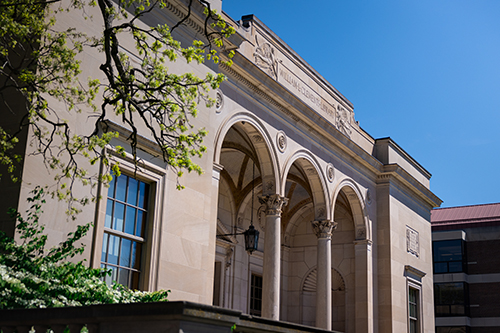
Photo courtesy of VP Communications, Regents of the University of Michigan