

Profoundly Public: The U-M Museum of Art’s Role in Teaching and Engagement
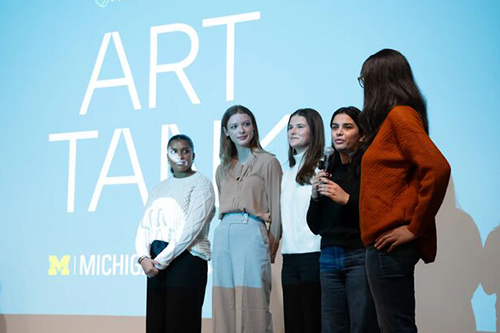
Photo by Leisa Thompson, Michigan Photography, U-M
This article is part of a series exploring cultural collections at the University of Michigan, particularly their role in teaching and civic engagement. Read the previous entry here.
The U-M Museum of Art (UMMA) is one of the few places on campus where students, faculty, and members of the Ann Arbor community share the same space, but experience it in entirely different ways.
One of the largest university art museums in the nation, UMMA is a major cultural institution and a vital part of intellectual life on campus. Its exhibitions and programs bring artists, scholars, students, and the public into conversation — expanding the role of art within the university and extending U-M’s cultural reach in the region.
As a hub for university teaching and learning, UMMA offers comprehensive, established resources for faculty: tours, custom study rooms curated with specific works not on display, and collection browsing based on academic themes to support both education and research.
But for southeast Michigan residents with no formal U-M affiliation, few campus institutions are as accessible for drop-in visitors to interact with their offerings free of charge.
UMMA was designed with open doors that invite a respite from the busyness of campus. There is no cost to visit and explore, and the mid-century furniture throughout the first floor is used daily by hundreds of students and others who pass through or take a break without ever seeing the galleries above.
“As the best university in the country, U-M has a profound commitment to the public and the museum is one of the most visible places where that commitment is fulfilled and felt,” said Christina Olsen, who has served as UMMA’s director since 2017. “Museums, along with public parks and libraries, are really where our idea of a public, and our experience of being a member of the public, take form. There is a lot of power and responsibility in that role.”
“Slightly more than half of our audience members are not university-affiliated, so we act as a kind of gateway to U-M.”
According to its latest Impact Report, the museum welcomed 179,000 visitors in 2025 and was integrated into the classroom experiences of 216 courses. Instructors, students, and residents are actively shaping its identity as a gathering place at the center of campus and public life.
More Than a Thought Experiment
Last fall, an innovative course launched as a partnership between UMMA and the Ross School of Business. The Business of Art (BE 460) explored the various intersections between art, economics, and curatorial decision making. The course was co-taught by Jennifer Carty, UMMA curator of art in public spaces and Tom Buchmueller, professor of business economics and public policy.
Throughout the semester, students in the course took a deep dive into the inner workings of the art market, meeting with curators, visiting galleries and museums in Chicago and Detroit, and talking with art experts as they developed acquisition proposals. Working in teams with an assumed $60,000 acquisition budget, they were tasked with identifying works that could meaningfully strengthen the museum’s collection — an exercise that required them to think across disciplines and to imagine how their proposed acquisition would resonate with the museum’s diverse future audiences.
On Dec. 1, 2025, students participated in a finale to the class: “Subject Matters: Art Tank,” a high-energy pitch competition at the museum where five student teams presented their final acquisition proposals before a live audience and a panel of UMMA curators.
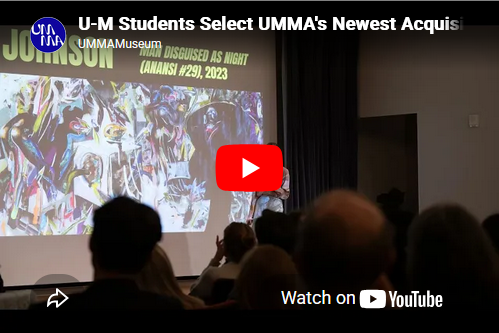
In describing the inspiration for the class, Olsen emphasized how UMMA and other campus museums have evolved as catalysts for teaching and learning. Early conversations with Ross School of Business Dean Sharon Matusik connected the relevance of art purchasing and curation to a variety of fields.
“To make a strong acquisition, you need a very interdisciplinary, holistic understanding of art and business. We both felt like it was a perfect pilot, because it demonstrates our belief that most complex, dimensional problems in the world are ones that a single discipline can’t really solve alone,” said Olsen.
“The students were really good at this, and represented a mix of arts, humanities, and business majors. This was a real acquisition that had to make sense financially – a good investment, and more than a thought experiment, that would ultimately be displayed on our walls.”
Providing the Arts to Neighboring Communities
Jennifer Gray’s love of art has driven her to museums around the world.
Her experiences in those spaces have given the 3rd-grade teacher at Estabrook Elementary in Ypsilanti firsthand knowledge of the power of interacting with art, about what it makes people feel, and the questions and conversations it prompts about the human condition.
Critically, she also understands the life-changing impact of passing that love on to students in her classes, and to her own children. So six years ago, when an opportunity arose for her class to visit UMMA as part of a collaboration with educational nonprofit 826michigan and Ypsilanti Community Schools, she was eager to take full advantage.
“The most exciting thing for me as a teacher was to see the amazement on my students’ faces and excitement in their eyes. They are always in awe of the artwork they see from the images on paper, to the real thing, and beyond,” said Gray.
“We got started when we were working on how to incorporate artwork with creative writing ideas and stories. We had the idea of using pictures, and having the students create a story behind what they thought might be going on with it. We then take a field trip to the museum to see the actual artwork.”
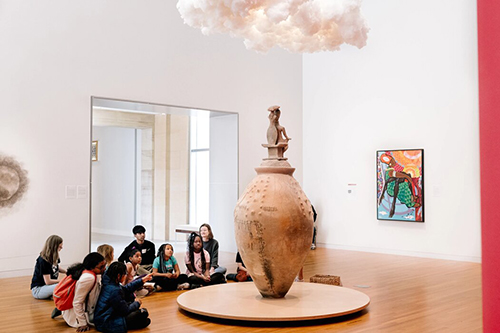
Ypsilanti Community Schools students visiting the University of Michigan Museum of Art. Photo by Britt Hueter.
Since then, more than 1,500 students have been able to experience UMMA as part of the program, where each year the collaborative stories are published into a book students can share with friends and family. Previous books are available to view on the 826michigan website.
The 2025-2026 academic year is the first that the museum has transitioned from volunteers to a professional team to deliver all K-12 tours after hiring a small cohort of Gallery Educators in 2022.
“As an educator, being able to work with these wonderful people has been a highlight of my career. It has impacted how I teach creative writing, as well as sharing the opportunity with other teachers in my building and throughout our school district,” said Gray.
“Visiting and seeing real artwork, in a museum, is something that the children in our school district don’t normally get to experience, and this collaboration allows for that.”
Woven Into the Civic Infrastructure
When Ann Arbor voters went to the Campus Voting Hubs in the 2024 General Election and recent midterms, some exceptionally inviting surroundings awaited them.
Thanks to UMMA’s partnership with the Creative Campus Voting Project at the Stamps School of Art & Design, the Ann Arbor City Clerk’s Office, and the UMICH Votes Coalition, the museum acted as a convenient, one-stop resource for voter registration, absentee ballots, early voting, and activities to promote civic participation.
Since 2020, UMMA has served as a venue for 37,000 voter registrations and ballots.
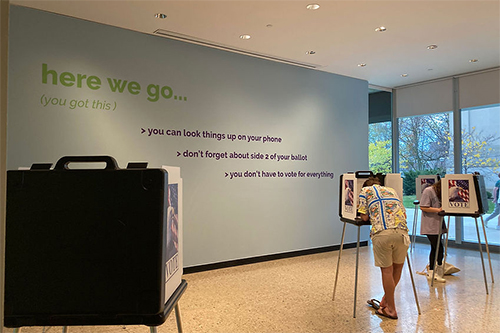
Photo courtesy of the Creative Campus Voting Project
“As designers of the Campus Voting Hubs, we can advance our creative research on how design supports civic learning, increases civic participation, and fosters a sense of civic identity,” said Stephanie Rowden, associate professor at Stamps and one of the co-leads of the Creative Campus Voting Project with Professor Hannah Smotrich.
“We feel fortunate to be part of such a unique partnership with our campus art museum and local government,” said Smotrich.
While plans are still under consideration for upcoming elections, the prospect of continuing to engage the public connects to something much larger for UMMA.
“Together, we were able to create an environment that is legible and delightful to people, to students, to anybody who votes in the city of Ann Arbor,” said Olsen. “That is a deep part of our mission – that the museum is part of the civic infrastructure of Ann Arbor. Serving as a voting hub is one tangible way we participate in that.”
“Our partnerships’ work is about the fundamentals of what a flourishing society requires, and part of that is art and beauty.”