

Talking Maize & Blue: A New Chapter for Open Inquiry at Michigan
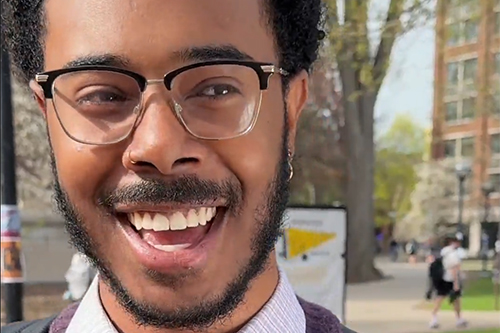
Initially, the questions are points of trivial – if sometimes passionate – disagreement. Does pineapple belong on pizza? Should we abolish Daylight Saving Time? But soon after, students experiencing Talking Maize & Blue, a new online education module required for first-year students, are asked about their perspective on highly-contested, ethically nuanced questions: is it wrong to eat meat? Should hate speech be censored?
Talking Maize & Blue launched on Aug. 18 with a bold aim: to foster a culture of open inquiry in the incoming class. As students taking the module respond to questions like those above, they can view recorded video responses to the questions from other students – and the responses run the gamut of viewpoints. These short video clips were filmed on the Diag and range from lighthearted to serious. It makes for compelling viewing, as each student unpacks the reasoning behind their responses.
Students can then see the percentage of respondents that share their view, e.g., 46% of respondents think pineapple belongs nowhere near a pizza. By the time the introduction is complete, a message is already surfacing organically: different perspectives are all around us, and can co-exist in dynamic ways.
The midsection of the module expands on three key pillars of U-M’s approach: inviting many prominent speakers, of diverging viewpoints, to campus; the importance of institutional neutrality and leaving politically charged statements and debates to be raised among members of its academic community; and the value of providing structured classroom discussions with ground rules for controversial topics.
Next up, Talking Maize & Blue introduces students to the “Michigan PAUSE,” a conversational framework for engaging with challenging ideas, and features a short explainer video about U-M’s principles and traditions of free expression and inquiry.
The one-hour interactive module is just the beginning: students are being invited to go deeper through a series of engagement opportunities during Michigan’s Year of Life-Changing Education in 2025-26, an interdisciplinary effort to underscore the ability for learning to improve society. Each element reflects a larger institutional commitment: preparing students to navigate disagreement civilly, curiously, and constructively.
“Talking Maize & Blue is grounded in the idea that disagreement isn’t a problem to be solved. It’s an intellectual opportunity to be cultivated,” said Paul Resnick, professor of information and chair of the Talking Maize & Blue task force. “We want students to understand that not everyone around them thinks the same way, and that’s not just okay, it’s part of what makes Michigan extraordinary.”
Resnick, who describes himself as a computational social scientist, has long been interested in how institutions structure productive disagreement. His previous work includes the design of online reputation systems and a series of studies on civility and polarization in digital spaces. “In some ways, Talking Maize & Blue is about translating those insights into campus life,” he said.
A Behind-the-Scenes Look at Talking Maize & Blue
Not All Wolverines Think Alike
The idea for Talking Maize & Blue grew in part out of the work of the university’s 2024 Principles Committee on Freedom of Expression and Diversity of Thought, particularly the recommendations of Subcommittee II. That subcommittee, chaired by Professor Mika LaVaque-Manty, called for a university-wide course introducing students to the values, norms, and complexities of expression on campus, as part of a broader “Pluralism Initiative.”
Vice Provost for Undergraduate Education Angela Dillard, who convened the Talking Maize & Blue task force upon being commissioned by Provost Laurie McCauley, sees it as part of a longer institutional arc. “The University of Michigan has a long tradition of open inquiry and engaging controversial ideas,” she says. “This effort reaffirms our belief that freedom of expression and intellectual pluralism are core academic values and that they can, and must, coexist with our commitment to inclusion.”
Still, talking about what some people term “viewpoint diversity” today can be complicated. To some, it’s a pedagogical cornerstone: a way to ensure students are exposed to a wide array of intellectual frameworks. To others, it’s become a proxy for political posturing. Nationally, debates over “viewpoint diversity” have been co-opted in some quarters as cover for ideological agendas. That ambiguity, however, makes a sincere commitment to open inquiry even more essential, according to Dillard, who is also currently serving as Interim Vice Provost for Access & Opportunity.
Echo Chambers, Epistemic Bubbles, and Self-Censorship
The university’s Principles on Diversity of Thought and Freedom of Expression, adopted by the Board of Regents in January 2024, reaffirm U-M’s responsibility to foster environments where competing ideas are vigorously tested. The accompanying report, which drew comments from more than 4,000 faculty, students, staff, and alumni, acknowledged that many on campus feel social pressures to self-censor. That feeling was most acute among individuals who hold politically conservative, libertarian, or traditionally religious views.
But the report also offered nuance. Concerns about expressive freedom were not confined to one side of the political spectrum. Students expressed fearing peer judgment. Some faculty worried about student backlash. Some staff members reported feeling professionally vulnerable. “Social incentives,” the report noted, “determine much of what we say and don’t, especially in public or professional settings.”
Some respondents used the term “echo chamber” to characterize their exposure to various viewpoints on campus; others expressed they encountered (and taught) a broad array of intellectual approaches. One’s mileage is bound to vary on a campus as large as Michigan’s.
A key insight into fostering a culture of open inquiry might be borrowed from the field of epistemology: the distinction between “echo chambers,” where opposing views are actively discredited, and “epistemic bubbles,” where they simply aren’t encountered due to social factors. While the former is more pernicious, the latter is more common and usually occurs incidentally. This makes the epistemic bubble easier to address through designs like Talking Maize & Blue.
“Supplementing the module is a set of cultural norms that have existed at Michigan for a long time, but which we’re now making more explicit,” says Dillard. “Students are putting ‘Talking Maize & Blue’ stickers on their laptops and water bottles to signal to each other that they’re interested in open dialogue, even about challenging topics.”
Resnick acknowledges many instructors might not see the value in the project right away, since they already encourage civil discourse and debate in their classrooms. But Talking Maize & Blue is about instilling the values of curiosity, charity, humility, and respect – what he calls the “guardrails of constructive conversations” – into private conversations between peers, as well.
This fall’s rollout of the module is only the beginning. Talking Maize & Blue was a key highlight of the annual “Party for Your Mind” Welcome Week event and is co-sponsoring events during Open Inquiry Week, scheduled for Oct. 6-10 in tandem with National Banned Books Week. On Oct. 8, author, social commentator and professor Glenn Loury will kick off a special speaker series to coincide with his recently published book, “Self-Censorship.” The task force hopes faculty and staff will contribute ideas and help scale participation.
“We think of the module as planting a seed,” Resnick says. “What grows from it depends on what we all do next.”
| TALKING MAIZE & BLUE TASK FORCE |
|