

On Course: Nature/Culture Now!
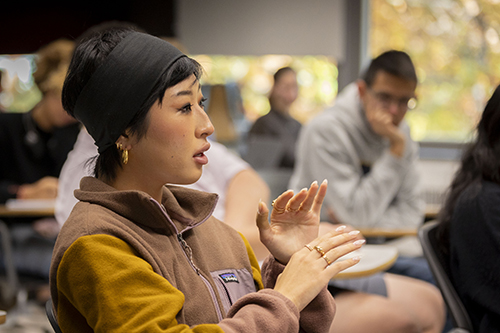
Photo by Kaley Joy, Office of University Development
The Michigan experience is defined by thousands of groundbreaking sections, courses, debates, and educators. With “On Course,” the Office of the Provost explores classes that are notable in their approaches or outcomes through candid, in-depth conversations.
Contentions over the primacy of nature or culture in the shaping of human bodies and behaviors drove some of the most heated debates of twentieth century American life. Nature/Culture Now! investigates the ongoing power of this opposition through an examination of anthropology’s central role in formulating the nature/culture dichotomy itself.
Throughout the course, students are challenged to become fluent with both biological and cultural approaches to human bodies and behavior. Debate is a central part of the class experience: its goal is to teach students how to think, not what to think.
Contributors:
 Tina Lasisi
Assistant professor and LSA Collegiate Fellow
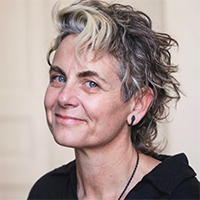 Elizabeth F.S. Roberts
Professor of Anthropology, LSA
What priorities or opportunities were most important in your development and planning for the course?
One priority was to give students a broad enough range of phenomena to see that the nature/culture distinction is not a specialized debate in anthropology, but a recurring problem in how knowledge is made. The course moves through four sections: history, race, sex and gender, and health and disease.
Across those sections, we ask students to examine where assumptions about nature and culture come from, how they shape scientific questions, and why they continue to matter in the United States. We wanted students to see that when biology is treated as fixed and essential, and culture as a separate add-on that can simply be changed, we lose the ability to understand the phenomena we claim to study.
The course therefore gives students practice moving between levels of analysis: bodies, histories, institutions, categories, methods, and lived experience. The opportunity was not just to cover many topics, but to show students that the same conceptual problem reappears across them: how we decide what counts as biological, what counts as social or cultural, and what kinds of explanations become possible once we draw that line.
Are there any moments or interactions that really hit upon your vision for debate and discourse around nature, culture, and anthropology?
One course example that students seem to really respond to is the set of assumptions built into how ACL injury is understood and treated. For years, sports medicine and the media have told a story that women are more prone than men to ACL injuries in sports. A great deal of research has then asked why, often locating the answer in nature or biology: women’s pelvises, hormones, menstrual cycles, or other bodily differences.
That search for a difference inside women’s bodies reinforces a much older story that women are inherently more vulnerable than men or less suited for physical activity. The Gender/Sci Lab at Harvard, which reexamines common stories about biological differences between women and men, reanalyzed studies of ACL injury rates and identified a problem in how those rates were being calculated.
What their reanalysis showed is that many studies that report higher ACL injury rates for women rely on the construct of athlete exposure, often defined as one athlete participating in one practice or competition. What that construct can miss is that practices and competitions are not organized in the same way across men’s and women’s sports. Women’s teams may have smaller rosters, less depth, and more playing time per athlete, all of which change the actual opportunity for injury.
Those differences are not biological; they are tied to long histories of unequal funding and institutional support for women’s sports, histories that are themselves connected to the same story that women are less naturally suited for athletic competition. The example helps students see that, when a difference appears between women and men, we often look first for the cause inside bodies.
The course asks them to also examine what seems cultural, the measurements, institutions, histories, and assumptions that make differences natural.
It sounds like lively debate was expected; what outcome or dynamic surprised you? What was unexpected?
When we first taught the course, we expected more overt debate. What has been more surprising is that, when we slow down and work through the intentions behind different ways of investigating a phenomenon, our views are often more compatible than they first appear.
Some of the friction comes from disciplinary vocabulary. The same terms can carry very different meanings across anthropology, the life sciences, and science studies; and terms such as nature, culture, politics, biology, and intent do different kinds of work in different fields. What can look like disagreement is sometimes a difference in emphasis, method, or vocabulary. That has become one of the most productive dynamics in the class.
It has also made us think differently about what we mean by debate. Debate presupposes two people who arrive with fixed positions and no real interest in changing them. What we are doing is something else: good-faith discussion, a mutual desire to understand the other’s perspective, and a shared effort to construct knowledge and discover things together. That distinction matters for how students understand what critical thinking actually looks like in practice.
Students have also been more open than we expected to working across those differences. Students coming from the social sciences need to understand evolutionary theory in order to make strong critical arguments about the history of racial thinking and why racial categories map poorly onto human biological variation. Students coming from the life sciences can use social-scientific tools, including material-semiotic analysis, to explain how statistics about ACL injuries emerge from histories of underfunding and institutional inequality in women’s sports.
The course works best when students see that critical thinking is not a matter of taking one side against another. It is learning how to ask what a question assumes, what evidence it permits, and what forms of explanation it makes available.
Can you describe the value of co-teaching this course in particular? How would it have been different teaching it alone?
This class could not be taught in the same way by one person alone. Tina is a geneticist and an expert on variation in skin and hair; she knows how knowledge is made in genetics, evolutionary biology, and the life sciences. Liz is a medical anthropologist who studies how phenomena often treated as biological, such as diabetes or antibiotic resistance, emerge through cellular, economic, political, and institutional processes.
If one of us tried to teach the other field alone, the result would necessarily be an interpretation of that field from the outside. It might be useful, but it would also be thinner: less current, less precise, and more likely to flatten the questions, methods, and internal debates that make the field what it is.
Co-teaching lets students see both forms of expertise operating in real time. The value is twofold. First, the information is more accurate, more current, and more precise than it could be if either of us were interpreting the other’s field from the outside. No one is better positioned to represent a discipline than someone who has spent years working inside it. If one of us tried to teach the other field alone, we would be offering an abstraction built from our own interpretation, and at its worst, that risks misrepresenting the questions, methods, and internal debates that make the field what it is.
Second, and just as importantly, students see knowledge being made through conversation in real time. They watch two scholars with different training, vocabularies, and commitments push each other to clarify what we mean and what our explanations can and cannot account for. That is very different from receiving a distilled, simplified account of what another discipline supposedly thinks.
It shows students that knowledge is not a single uniform thing that is either correct or incorrect, nor a linear accumulation of settled facts — and that two people who have each studied their field for decades can have rich, unresolved, generative disagreements. That organic quality is unlike most courses, and it is something a single instructor cannot produce alone.