

Mythbreaking: The Affordability of a Michigan Education

Affordability is a practical question for families considering college. At the University of Michigan, a wide range of assistance is available that factors in families’ financial circumstances and expenses beyond tuition.
In this edition of Mythbreaking, we examine some common assumptions about the cost of an undergraduate education on U-M’s Ann Arbor campus.
Myth: “You can tell what a student will pay by looking at the published price.”
Fact: Students who receive grants and scholarships can pay substantially less than the published costs. A useful figure for comparing colleges is net price: the estimated total cost of attendance after grants and scholarships are subtracted.
U-M’s net price calculator helps prospective students estimate their costs and potential financial aid before receiving an individual aid offer. When comparing net price, UM-Ann Arbor offers one of the lowest costs among 15 public institutions in Michigan for the majority of Michiganders.
Myth: “Families earning six figures won’t qualify for significant financial aid.”
Fact: The Go Blue Guarantee covers tuition and mandatory university fees for qualifying Michigan resident undergraduates with family incomes of $125,000 or less and assets below $125,000. Students must meet the program’s enrollment and financial aid requirements.
Support also extends to some families above that threshold. The Office of Financial Aid publishes the following examples for 2025–26 in-state undergraduates:
| Family Income | Average Tuition After Grants and Scholarships |
|---|---|
| $125,000–150,000 | $967 |
| $150,000–180,000 | $2,377 |
Individual aid depends on a family’s circumstances.
Myth: “Financial aid can cover tuition, but families are on their own for housing and other expenses.”
Fact: U-M commits to meeting the full, demonstrated financial need of eligible Michigan resident undergraduates who meet application deadlines. That calculation considers an attendance budget that includes housing and meals, books and supplies, and other educational expenses.
Meeting demonstrated need can involve grants, scholarships, loans and Work-Study. The Go Blue Guarantee itself generally covers tuition and mandatory fees; additional assistance depends on eligibility.
In addition, resources such as the Michigan Undergraduate Laptop Program, which provides free laptops to eligible incoming students on the UM-Ann Arbor campus, help to offset the cost of attending. Thousands of incoming first-year and transfer students have participated in this program since 2015.
Myth: “Tuition increases make U-M less affordable for Michigan families.”
Fact: U-M increases the aid budget every year to offset tuition increases for resident students with need. For 2026–27, U-M paired a 3% increase in resident undergraduate tuition and fees with a 3.8% increase in undergraduate grant aid, bringing that aid budget to more than $335 million.
The university designed the increase in aid to offset the higher cost for resident undergraduates with financial need. When adjusted for inflation, families with annual incomes up to $120,000 will pay a net price at U-M today that is less than families of similar means paid a decade ago.
Myth: “Most Michigan resident students leave U-M with student loan debt.”
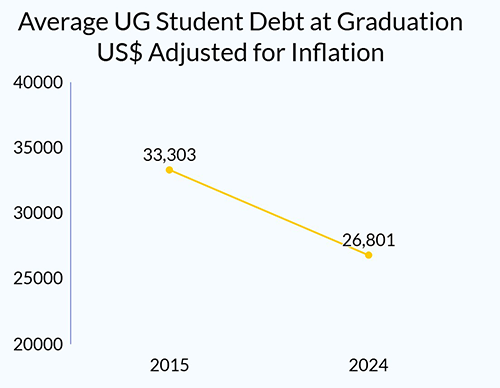
Fact: In U-M’s 2024 graduating class, 62% of in-state undergraduates completed their degrees without student loan debt. Across all undergraduates, the figure was 68%.
The Office of Budget and Planning also reports that average debt among undergraduate borrowers has declined over the past decade when adjusted for inflation:
Myth: “Students from outside Michigan cannot receive financial aid from U-M.”
Fact: Nonresident undergraduates who meet financial aid eligibility requirements can receive institutional need-based aid.
While our Go Blue Guarantee and full-need pledges are designed specifically for in-state undergraduates, our investment in financial aid extends campus-wide, with more than half (51%) of our out-of-state undergraduates receiving some form of aid.
Additional information for non-resident students may be found here.
Myth: “The Go Blue Guarantee is only available to students who enter U-M as first-year students.”
Fact: Eligible transfer students and continuing undergraduates can also receive the Go Blue Guarantee. Eligibility is assessed through the financial aid application process and reviewed annually.
The Go Blue Guarantee is U-M’s commitment to cover undergraduate tuition and mandatory university fees for up to four academic years. Students who did not qualify in one year may qualify in a later year if their circumstances change.
Myth: “Once a financial aid offer arrives, it cannot change, even if a family’s finances do.”
Fact: A significant change in family circumstances can warrant another review. Job loss, high unreimbursed medical expenses and other financial disruptions are among the circumstances the Office of Financial Aid can consider.
Some students, or their families, experience unique circumstances that affect the ability to pay college costs. Families should contact the office promptly about a review or appeal. Additional assistance depends on the circumstances, documentation, timing, and available funds.