

Get to Know: Dialogue Michigan
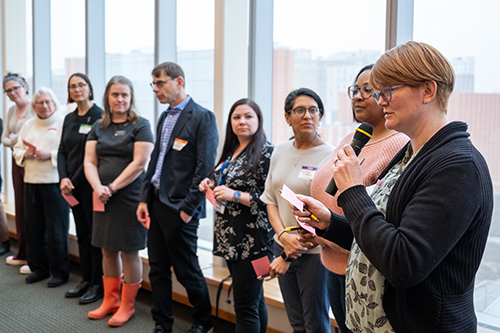
Photo courtesy of Dialogue Michigan
Dialogue Michigan is supported by The Program on Intergroup Relations (IGR), which was founded in 1988. It is the oldest and most established program of its kind in higher education. The Michigan Model of Intergroup Dialogue has been adopted by more than 250 institutions, and its peer-facilitated courses and CommonGround workshops have shaped the field nationally while educating generations of U-M students.
In 2025, more than 750 individuals from 89 departments across the university participated in the “Difficult Dialogues Meet the Moment” initiative. Designed to prepare faculty, staff, and students to discuss difficult emerging topics, the initiative was supported by a broad coalition that included LSA Undergraduate Education; Student Life; the Raoul Wallenberg Institute; U-M Year of Democracy, Civic Empowerment, and Global Engagement; The Program on Intergroup Relations (IGR); and the Difficult Dialogues National Resource Center.
Building on that momentum, the initiative has now become Dialogue Michigan — launched in January 2026 to empower communities across U-M with expanded workshops, access to practitioners, collaborative opportunities, and new resources to address complex realities. The program is incubated in IGR, positioning it to draw on and strengthen U-M’s impact as a national leader in dialogue practice, and ensuring that campus continues to be a place where transformative discussions thrive.
As the University of Michigan strengthens its leadership in civic problem solving and discourse with the Center of American Dialogue, Dialogue Michigan continues to broaden and deepen this practice on the campus and provide support through its network of practitioners and scholars.
What Does Dialogue Michigan Do?
Dialogue Michigan functions as both a convener and a laboratory for dialogic practice at U-M. Its offerings are organized around three interconnected resources.
The first is the Campus Dialogue Network, a catalog of U-M faculty and staff who are already trained in dialogue facilitation and best practices. Anyone with an interest in dialogic education is welcome to join, and the network makes it possible to find collaborators, co-facilitators, and colleagues across units who are working on similar challenges.
The second is a suite of asynchronous tools and workshop curricula developed and tested within the U-M ecosystem. The Difficult Dialogues toolkit provides resources for anyone who wants to build dialogue capacity into their courses, departments, or teams without waiting for a scheduled workshop.
The third is live programming: expert-led workshops and programs available to anyone in the U-M community. These sessions draw on decades of research and practice to give participants concrete skills for navigating disagreement, building understanding across differences, and sustaining productive engagement over time.
Built on Decades of Practice
Dialogue Michigan is supported by IGR, which was founded in 1988 and is the oldest and most established program of its kind in higher education. The Michigan Model of Intergroup Dialogue has been adopted by more than 250 institutions, and its peer-facilitated courses and CommonGround workshops have shaped the field nationally while educating generations of U-M students.
The response to “Difficult Dialogues Meet the Moment” last year confirmed what IGR has long understood: the appetite for this work at U-M runs deep, and it extends well beyond the classroom.
Adan Hussain serves as Dialogue Michigan’s inaugural director, bringing more than a decade of experience in higher education strategy and program development, including previous work adapting the Michigan model of dialogue at Ohio State and with First-Generation Gateway programs serving more than 4,000 first-generation students.
“Dialogue is a powerful tool for fostering understanding, especially when divisive rhetoric keeps us from learning from one another,” said Hussain. “We should not shy away from engaging across our differences, and I am proud to lead an initiative that invests so deeply in our community’s capacity for transformative dialogue.”
A Growing National Role
The launch of Dialogue Michigan coincides with a significant development beyond campus. The Difficult Dialogues National Resource Center, an independent organization with deep roots in higher education dialogue work, has voted to pursue an institutional affiliation with U-M, with IGR and LSA serving as its administrative home. The partnership will expand resources, training, and national programming while keeping intergroup dialogue and relations education at the center of IGR’s mission.
The affiliation reflects U-M’s reputation for practicing and advancing this important work. Dialogue Michigan is the next expression of that commitment, and an open invitation to the entire campus community to play a part.
Faculty and staff interested in workshops, the Campus Dialogue Network, or on-demand resources can learn more by visiting the Dialogue Michigan website.