

Five Questions for: UROP’s Michelle Ferréz
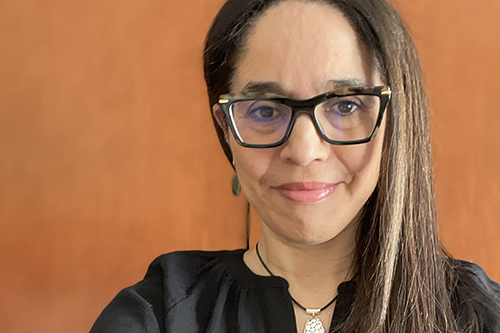
Michelle Ferréz has served as director of the Undergraduate Research Opportunity Program (UROP) since 2018, and is now the assistant vice provost for undergraduate research & student success in addition to her director role. UROP is in the process of transforming into the newly established Center for Research, Scholarly, and Creative Inquiry, reflecting an institutional commitment to enhancing scale and equitable access across U-M’s diverse student body of more than 32,000 undergraduates.
Ferréz is a highly accomplished and dedicated higher education professional with nearly 30 years of distinguished experience in programs akin to the one she now leads, specializing in institutional transformation, student success, and student development.
1) Where does the UROP transition stand as of today, and what excites you most about the process?
UROP’s transition to a Center for Research, Scholarship, and Creative Inquiry is currently in a “scaling and integration” phase. While UROP’s core functions — matching students with mentors, hosting research seminars, providing research training and development — remain active, the focus has shifted toward university-wide infrastructure. We are actively aligning our research opportunities with the broader ‘Student Success’ mission, ensuring that research isn’t just an add-on, but a core component of the undergraduate experience.
What excites and energizes me the most is the intentionality behind this evolution. This isn’t just a name change; it’s a commitment to three key areas that I find incredibly powerful: First, the expansion of ‘Creative Inquiry.’ Secondly, as a ‘Student Success’ leader, I am most excited about our ability to use data to remove student barriers. And finally, I’m excited by the ‘multiplier effect’ of being a center. We are now a bridge between faculty and the 32,000+ undergraduates on this campus.
2) For those in the U-M community that may be familiar with UROP’s history and its impact on student success, what will be changing – and what will be staying the same?
We are taking UROP’s unique blend of mentorship and discovery and making it a permanent, structural part of the Michigan experience. We aren’t changing who we are; we are expanding what we can do and who we can reach. It surely is not a departure from our roots, but instead, an institutional elevation of a proven model.
While we are keeping the “UROP” name, our core pedagogy remains. Students will still benefit from peer-facilitated seminars, one-on-one faculty mentorship, and the intensive, year-long commitment that makes this a “high-impact” practice. Meanwhile, we now have a formal mandate to serve all 19 schools and colleges with a centralized, scalable infrastructure. My dual role as Assistant Vice Provost allows the Center to move beyond “finding projects” for students. We are looking at the whole student —using data to ensure research participation correlates with higher retention, belonging, and career readiness.
3) Student connection with researchers has been cited as one of the core strengths of UROP programs. How will those connections grow as the center moves forward?
Historically, students often viewed “researchers” through a STEM-centric lens. By centering Scholarship and Creative Inquiry, we are actively recruiting a broader range of mentors, something UROP has always been committed to. The Center will act as a matchmaker across disciplines, helping a computer science student connect with a digital humanities professor, or a public health student with a policy researcher.
We are also launching new resources for faculty and graduate student mentors to help them move beyond assigning tasks toward fostering a student’s identity as a scholar. We want the connection to last longer than a single academic year. The Center will provide pathways for students to transition from “learning the ropes” to lead researchers or co-authors on publications and exhibitions.
4) Your individual leadership, and the UROP task force, have prioritized peer data and best practices to support a scalable blueprint for the transition. What best practices stand out to you, and how do you envision that U-M will adapt them for our community?
First, data shows that “relational” mentorship is the single greatest predictor of student persistence. We are scaling UROP’s mentorship training for faculty, and expanding the role of Graduate Student and Postdoctoral Research Mentors.
Next, leading centers have moved away from static “job boards” toward algorithm-based matching systems that account for student skills, interests, and availability. In the future, we hope to launch a new Discovery Portal, which will allow our community to find interdisciplinary connections that were previously hidden in departmental silos.
Lastly, leading institutions use predictive analytics to identify “at-promise” students who would benefit most from early research exposure to increase retention and belonging. At U-M, we are integrating UROP data with university-wide success metrics, and no longer treating research as an “extracurricular.”
5) What takeaways from your life and academic career have shaped the programs, resources and support you’re able to provide to students?
My commitment to student success is not just a result of my doctoral work and my research; it was born out of my time as an undergraduate student at UCLA in the early 1990s. As a first generation, Latina student, I was a student during a period when the very foundations of equity and access in the state of California were under coordinated attack. I witnessed firsthand how quickly progress can be reversed if access and student success programs are ‘programmatic’ and not ‘institutional.’
I experienced and felt what many students are experiencing today. The anxiety, the fear, the worry, and the shifting climate of belonging on campus as policies began to change. That experience taught me firsthand that access is a fragile right. It is why I have spent 30 years ensuring that my work is not just about creating opportunities for students, but creating permanence. It taught me that we cannot leave student success to chance or to the political whims of the moment.
| MORE INFORMATION |
|