

Creativity, Breadth Driving Disability Scholarship Initiative
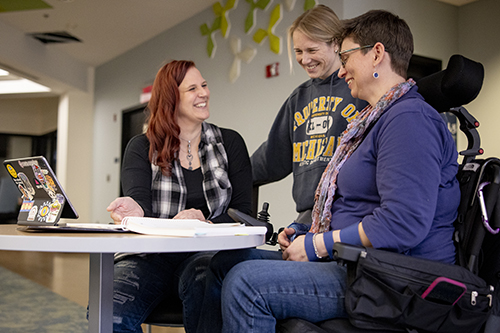
Photo courtesy of Marc-Gregor Campredon, Office of University Development
The Disability Scholarship Initiative aims to transform the U-M experience for faculty and staff with disabilities — and the six teams awarded funding through the project are taking a uniquely collaborative and synergistic approach to their ongoing research efforts.
The initiative, launched by the Office of the Provost in February, aligns with institutional commitments to creating a more accessible campus. From its outset, it was designed to embrace a broad definition of disability including mental, physical, sensory, and cognitive differences. All funded proposals support the impact areas of health and well-being and life-changing education prioritized in the Look to Michigan strategic framework.
“We were pleased by the tremendous response to the Disability Scholarship Initiative earlier this year, and it is rewarding to see its many cross-discipline collaborations in action,” according to Provost Laurie McCauley. “Our teams have a bold vision for creating sustainable, positive changes for our colleagues with disabilities, and their efforts so far show a promising trajectory toward that outcome.”
A Rich Variety of Perspectives
A call for proposals went out in fall of 2024, with two mechanisms offered: the Emerging Scholars Program, which supported PhD students or postdoctoral fellows; and the Catalyst Program, led by faculty of any rank and track with up to three years of funding. The Provost’s Office received 22 proposals spanning nearly every school and college on campus. Of these, an external panel of reviewers recommended six proposals for funding, one an Emerging Scholar project and the others in the Catalyst Program.
“It’s an especially collaborative and thoughtful group of people. Each project comes from a different area of expertise, so every meeting brings fresh perspectives and approaches.”
— Ciara Witt, Project Manager, “Disability and Research Safety Infrastructure”
In emphasizing work that would increase the understanding or address concerns of Ann Arbor faculty and staff with disabilities, the projects were encouraged to be interdisciplinary and to incorporate differing methodologies, interventions, and approaches. As a result, principal investigators, researchers, and other team members represent areas as wide-ranging as architecture, ethics, medical and cultural anthropology, generative AI, biomedical engineering, and finance.
“It’s an especially collaborative and thoughtful group of people. Each project comes from a different area of expertise, so every meeting brings fresh perspectives and approaches,” notes Ciara Witt, project manager for “Disability and Research Safety Infrastructure” in the Department of Orthopaedic Surgery. “We’re not only sharing ideas and resources, but also thinking carefully about how to survey our sometimes-overlapping populations in a way that’s thoughtful, clear, and avoids overwhelming anyone.”
“The interdisciplinary nature of the group has made those discussions rich and really strengthens the impact of the initiative as a whole.”
Creative Strategies to Engage
The overall window for the teams’ outreach and data collection activities is expected to stretch into fall of 2026, allowing for a thorough exploration of the entrenched, historical challenges common among communities that are disabled. Acknowledging these realities at U-M, while making use of novel tactics to capture the voices of these groups of employees, has been pivotal.
“Faculty and staff with disabilities remain largely isolated and underrepresented across our medical campus. This project presents an important opportunity to learn more about their experiences in the workplace,” says Dr. Michael McKee, professor in the Department of Family Medicine and principal investigator for the “Michigan Medicine Workplace Equity for Individuals with Disabilities” Catalyst Program.
“I am particularly excited about the potential to develop creative strategies that empower these individuals to thrive in health care settings. Ultimately, this initiative will help ensure that this valuable segment of our workforce is recognized and supported.”
McKee cites a 2016 University of Michigan Faculty Campus Climate Survey, which found that 3.5% percent of faculty members self-reported a disability, and that faculty with disabilities were 73% more likely to report discrimination at U-M compared to their non-disabled peers.
Versatile Options for Sharing Insights
The various teams’ early lessons have been abundant, shedding light on meaningful ways to better understand and address gaps in access to important systems, pathways, and resources. While the potential for strengthening U-M’s culture around safety and disability is vast, the greatest advantage in convening such a large, dynamic pool of experts may be the versatility in how their learnings are applied.
“The most exciting part is having useful information that the university could make use of quite immediately, but also over time,” notes Joy Knoblauch, associate professor of Architecture and principal investigator for the Catalyst Program titled, “What does a quiet working space look like? Visualizing faculty and staff preferences at the U-M.”
“As is often the case with the disability community, the sharing of ideas and resources has been enthusiastic and warm. We’re looking at overlapping questions, so it’s been great to discuss and support each other.”
| INFORMATION AND RESOURCES |