

A Shared Legacy: The U-M Humanities Collaboratory and Assessment Hub
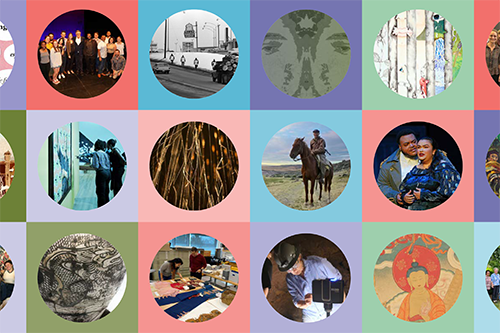
In the traditional view of humanities research, the work is often solitary: closely studying libraries of archived materials, or performing lone fieldwork in remote locales. But in a bold project taking place from 2015 to 2025, the Michigan Humanities Collaboratory explored what might happen with more partners and collaborative methods in the process.
Designed and established by the Office of the Provost and administered by LSA, the Collaboratory was built on the premise that large-scale, high-impact humanities inquiry can be accomplished with research teams, and that humanists doing ambitious, public-facing work deserve institutional support, as colleagues in STEM fields receive. In practice, that meant new kinds of infrastructure, as well as funding over a ten-year period, project management support, connections to campus experts, and help forging partnerships with communities beyond the university.
While the project reached its planned conclusion in 2025, an online archive of the projects and outcomes funded by the Humanities Collaboratory gives visitors a sense of the initiative’s scope and continuing impact.
“The Collaboratory was really shaped by the idea that our colleagues in STEM structurally have all of these opportunities. It’s assumed that you’re going to collaborate,” said Kristin Hass, professor in the Department of American Culture at LSA and faculty coordinator for the Collaboratory from 2017-2025. “Our thought was to treat it as an experiment: what would happen if we gave people in the humanities a chance to play with that structure?”
“We gave larger grants, and that scale of support distinguished the Collaboratory from other granting opportunities at Michigan and elsewhere.”
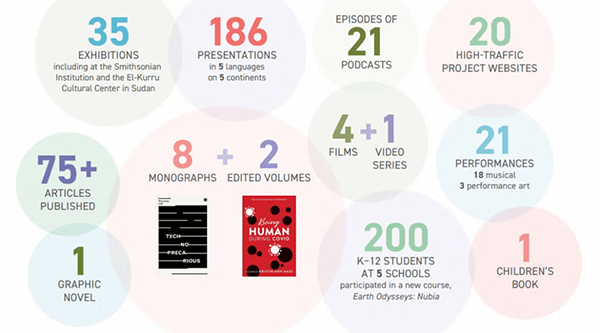
In its ten years, the Collaboratory awarded 72 competitive grants and engaged more than 500 participants, including faculty, graduate students, undergraduates, librarians, postdocs, and community partners drawn from 12 of U-M’s 19 schools and colleges. The work that emerged was enormously diverse: 186 scholarly presentations delivered in five languages on five continents; more than 75 published articles; 35 exhibitions, including installations at the Smithsonian Institution; 21 performances; 4 films; and even a graphic novel and a children’s book. More than 67 community organizations contributed to or were shaped by this research.
The financial returns were notable. The university’s initial $10 million investment has generated at least $13.3 million in external funding — a figure the Collaboratory’s final report describes as conservative, given ongoing and canceled activities not yet fully accounted for. As the Chronicle of Higher Education noted in 2018, U-M stood out nationally for its eagerness to take on expansive, collaborative humanities projects at scale.
The Collaboratory also proved to be a powerful engine for student development. More than 200 graduate and undergraduate students participated in funded projects, and alumni have gone on to tenure-track faculty positions at institutions including the University of Chicago, the University of Texas at Austin, Penn State, and the University of North Carolina at Chapel Hill, as well as fellowships at Harvard, Princeton, Cornell, and the American Council of Learned Societies.
“The overarching mission was culture change,” said Hass. “In terms of experimenting with forms as well as doing collaborative, public-facing work that promotes healthy, robust careers in the humanities.”
“Our graduate student placement was incredible. Graduate students getting tenure-track jobs in the humanities right now is really tough. Despite that, our graduate students, to a person, all have amazing jobs.”
A Lasting Impact
The 21 two-year project grants funded by the Collaboratory were wildly varied. A team of scholars traced an eighth-century monk’s journey through the medieval Buddhist world. Historians pieced together the culture and social policies affecting Black families in Washtenaw County during the early and mid-20th century. Musicians and musicologists explored the relationship between American music and the civil rights movement. An animated film made its way to a prestigious festival in France.
Despite their wide-ranging concentrations and formats, the projects shared a common method: to bring more humanities researchers together in creating visible works beyond the traditional monograph.
The Precarity Lab collected a team from diverse fields and practices to explore how inequality and insecurity is generated by digital technologies — from the placement of Palestinian internet cables and the manufacture of electronics by Navajo women to the deployment of drones on the U.S.–Mexico border. The research produced a white paper, a peer-reviewed article, and an open access book.
“We were moving collaboration forward from the footnotes or acknowledgments to the front page, to really think about interaction and shared knowledge-making,” said Iván Chaar López, assistant professor in the Department of American Studies at the University of Texas at Austin who contributed to The Precarity Lab as a graduate student at U-M.
“There was also a deliberate effort to bring together multiple generations — not only in terms of age, but people in different stages of their career. Since then, we’ve kept our conversations going at conferences, and we keep collaborating in different ways.”
Beyond its many publications and exhibitions, the Collaboratory’s more meaningful outcomes were individual and sustained: faculty, students, archivists, and community partners emerged from the experience with new skills, new questions, and in many cases, new directions for their careers.
“Whenever we visit the institutions we collaborate with, be it the Bentley Historical Library, the U-M Museum of Anthropological Archaeology, or the University Library’s Special Collections Research Center, we see changes they have implemented because of our project,” said Deirdre de la Cruz, a principal investigator for ReConnect / ReCollect, one of the two-year projects funded by the Collaboratory that examined the accumulation of some of the largest Philippine archival, cultural, and natural history collections in North America.
“We have made a difference in these institutions, and inspired other institutions around the country to emulate what we have done here at Michigan.”
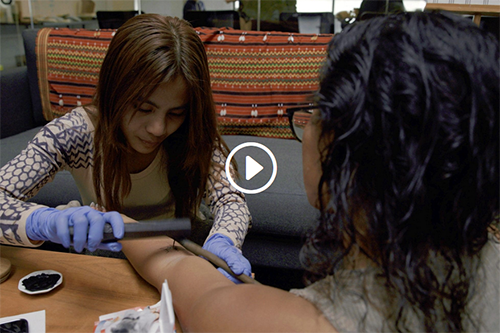
View “Points of Origin,” a documentary film about ReConnect / ReCollect by Orlando de Guzman
Bridging the Gap
One of the Collaboratory’s enduring contributions is a purposeful effort to change how humanities scholarship is evaluated. For faculty doing collaborative, digital, or publicly engaged work, traditional tenure and promotion processes have sometimes struggled to keep pace. A team-produced documentary, a community archive, or a public exhibition doesn’t always map neatly onto the traditional criteria familiar in humanities fields.
The Humanities Assessment Hub, born of learning from the Humanities Collaboratory, was built to address that gap. The searchable, user-friendly web archive collects frameworks, guidelines, and resources developed over more than two decades by leading humanities organizations including the Mellon Foundation, the Modern Language Association, and the American Historical Association, among others. Its resources are designed for scholars navigating the tenure process, as well as the department chairs and institutional leaders who steward processes to evaluate them.
The Hub was developed through the Collaboratory and will continue to be maintained by the LSA Research Office, providing an institutional home with long-term support. Its development included a community workshop in April 2025, convening a panel of national scholars and humanities leaders to help shape the resource before the Collaboratory’s formal conclusion.
As the Collaboratory’s outcomes make clear, the next generation of humanities scholars is already producing work in new forms that are public, interdisciplinary, and deeply engaged with communities outside U-M. The Hub exists to ensure that institutional processes evolve alongside that work, creating what its architects describe as “new pathways for more equitable and rigorous support” for scholars across the field.
Where the Collaboratory gave scholars the resources to do bold work, the Assessment Hub works to ensure those innovations will continue to be recognized and rewarded.
“I think there are many faculty who see themselves as somebody who could collaborate, who could say something useful about the world in 2026 based on what they’re studying from 1640,” says Hass.
“The Hub was created as a resource to help people make the best arguments they can about why the work that they are producing should be considered scholarship, and why it should be considered in tenure and promotion.”
Together, the projects and approaches created by the Collaboratory, and the evolution in ways of understanding the value of humanities research represented in the work of the Assessment Hub, mark a milestone in the culture change sought by their creators.
“The Humanities Collaboratory, both in its specific projects and its design, is overwhelming proof of concept: that the 21st-century practice of the humanities can have lasting impact in the world, at scale, and for shared knowledge creation that inspires the next generation of learners and serves our communities,” says Sara Blair, vice provost for faculty affairs and for arts & humanities, who led in the Collaboratory’s design.
“Addressing our most urgent challenges will require increasingly collaborative work. The achievements of the Collaboratory position the humanities at Michigan to take leadership in that work, across the challenges the university is committed to confronting.”