

Advancing Innovation in Teaching and Learning at Michigan

Photo courtesy of the Center for Academic Innovation
The University of Michigan’s commitment to shaping the future of learning comes to life through its faculty. Their expertise, curiosity, and commitment to innovation generate the ideas that help U-M respond to changing educational needs while keeping meaningful learning at the core of its mission.
The Center for Academic Innovation partners with faculty to put those ideas into practice. For more than a decade, these collaborations have produced online courses, certificates, and degree programs that have helped more than 12.9 million learners around the world through Michigan Online. The center also worked with faculty to develop software tools such as Atlas, used by more than 99% of Ann Arbor undergraduate students to plan their curriculum.
Technology’s role in learning
Innovative approaches are always evolving, and that is why the center works closely with faculty on emerging technologies. That includes exploring artificial intelligence’s role in teaching and learning, as well as immersive education using extended reality technology. It also means using advanced technologies in online learning to help alumni and learners off campus navigate their careers and the evolving workplace.
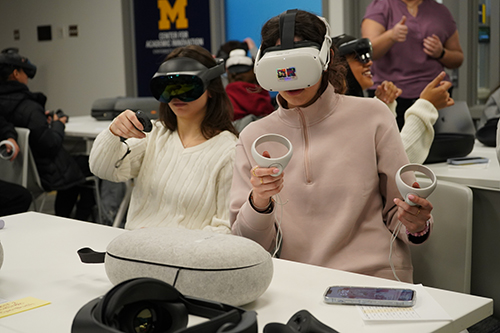
Photo courtesy of the Center for Academic Innovation
Partnership and funding opportunities for faculty
To many faculty, the center has become a second “faculty lounge” — a welcoming space to connect with peers, discuss ideas, and collaborate with center staff. As steward of the university’s Academic Innovation Fund, the center also offers funding and support to faculty through frequent calls for proposals.
This fall, the center has opened three calls for proposals that offer ways for faculty to pursue ideas to advance life-changing education at Michigan through non-credit online courses, for-credit online programs, and the implementation of AI in teaching and learning. Faculty can propose projects that draw on their disciplinary knowledge and teaching experience and work with the center to develop new educational opportunities. The center also offers consultation opportunities to help faculty develop their ideas and navigate the proposal process.

Photo courtesy of the Center for Academic Innovation
Events to share insights, ideas
Every year, the center also hosts signature events for faculty to help shape new approaches to innovative teaching. Previous years featured multi-day AI summits, campus presidents and provosts managing the changing landscape, and industry and faculty experts discussing how they are shaping the future of learning.
This year, the center is hosting an AI Futures series that brings different perspectives regarding AI and learning. The next session will feature Julie Schell of the University of Texas at Austin, who will discuss her work on using AI as a Socratic tutor.
The center is also hosting an ongoing Generative AI Faculty Forum series, which provides another space for faculty colleagues to exchange ideas and reflect on teaching practices. Its next session focuses on AI’s role in course design, and features Frederique Laubepin, School of Public Health, and Kevin Miller, Marsal Family School of Education.
The challenges of delivering a world-class education through dramatic technological change are substantial. Through project support and opportunities for dialogue, the center connects faculty expertise with resources and colleagues to advance new approaches to teaching. These partnerships help U-M respond to changing educational needs while ensuring that faculty play a central role in shaping the future of learning.

Photo courtesy of the Center for Academic Innovation