

Mythbreaking: Archaeology’s Relevance, With the Kelsey Museum
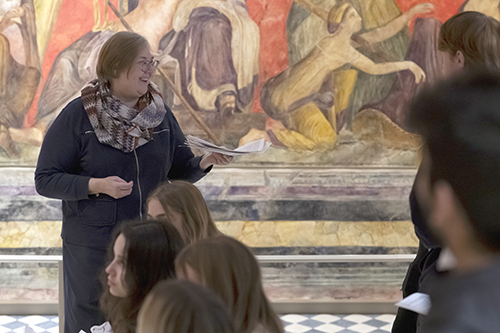
Photo courtesy of the Kelsey Museum
The ability to engage openly and across differences — to question assumptions, sit with complexity, and listen before concluding — is among the most important capacities a university can cultivate. At the University of Michigan, that commitment is embedded in curricula and research, as well as the informal spaces where learning happens.
Founded as a teaching resource to enrich students’ education, the Kelsey Museum of Archaeology is one of those informal learning spaces where the ancient world is brought to life. In this edition of Mythbreaking, experts from the Kelsey Museum address some common misconceptions about one of U-M’s most extraordinary resources for teaching and learning.
Contributors:
- Emily Allison-Siep, Communications Editor
- Jennifer Kirker, Associate Director
Since 1928, the Kelsey Museum of Archaeology at U-M has sponsored archaeological research and collected more than 150,000 artifacts from the ancient Mediterranean, North Africa, and the Middle East. Free and open to the public, it serves as both a research institution and a teaching resource — and as one of the most distinctive spaces on campus for the kind of open inquiry and cross-cultural engagement that define a Michigan education.
Yet a number of persistent myths keep some faculty, staff, and students from taking full advantage of what the Kelsey offers.
Myth: Only classes directly related to history and archaeology are enriched by customized programming from the Kelsey Museum.
Fact: This past academic year, the Kelsey welcomed nearly 4,000 University of Michigan students through its doors — and while many came from traditional partner departments like History of Art, Middle East Studies, and Classics, a significant and growing portion came from programs you might not expect. Students from the Stamps School of Art and Design, Taubman College of Architecture and Urban Planning, and programs across the social sciences and humanities have all received personalized programming at the Kelsey, with museum staff working directly with faculty to design gallery tours, object handling, and other experiences relevant to their specific courses and questions.
The collection’s depth makes this kind of cross-disciplinary engagement possible. For a design student examining ancient Roman craft traditions, an architecture student studying spatial organization in Egyptian tomb complexes, or a public policy student tracing how material culture shapes civic identity, the Kelsey’s more than 150,000 artifacts can spark conversations across an enormous range of disciplines.
Faculty interested in bringing a course group to the Kelsey are encouraged to reach out directly to museum staff to discuss programming options.
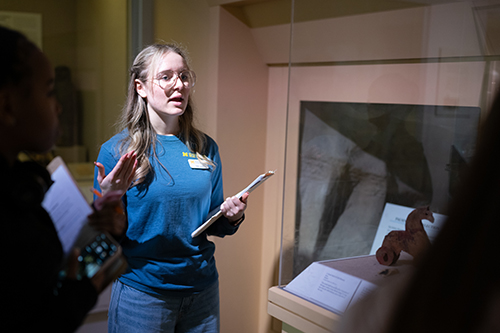
Photo courtesy of the Kelsey Museum
Myth: Archaeology at the Kelsey focuses primarily on Western culture and its origins.
Fact: The Kelsey’s collections span an enormous geographic and cultural range, including ancient Mesopotamia, Egypt, Greece, Rome, Iraq, and the Middle East. While this scope does include Western culture, the focus is on the daily life of the average person and the remarkable similarities across these regions and through time. Through rich storytelling, the museum helps ancient objects resonate with contemporary visitors.
This summer, the Kelsey is opening a major new permanent gallery dedicated to Byzantine and Islamic art and material culture. The gallery reflects the Kelsey’s commitment to presenting the ancient and medieval world not as a series of isolated social groups but as a sustained, complex conversation across cultures, faiths, and geographies.
The objects in this gallery — textiles, coins, pottery, manuscript fragments, architectural elements — moved across borders, changed hands, and accumulated meaning over centuries. They are, in a very literal sense, artifacts of exchange.
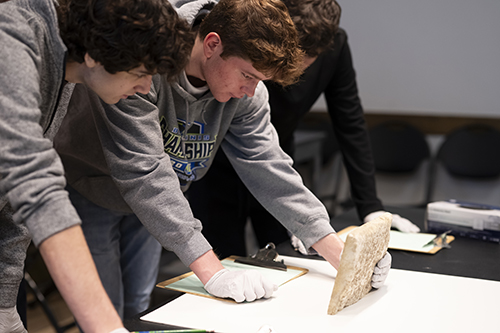
Photo courtesy of the Kelsey Museum
Myth: Ancient history and archaeology have little to say about the questions and debates we face today.
Fact: The ancient world was not a simpler place. The Mediterranean and Middle Eastern cultures represented in the Kelsey’s collections were marked by pluralism, migration, religious diversity, and sustained contact across difference: social and civic complexities with continuing resonance today.
The Kelsey engages these connections directly. Its public tours address topics ranging from politics and propaganda to death and daily life; its K–12 outreach brings students from across metropolitan Detroit into contact with objects and stories that expand their understanding of the ancient world and their own. And the museum’s scholarly work, including active fieldwork on three continents, continues to surface new perspectives on how people have always navigated the challenges of living alongside those who are different from them.
Myth: You can only visit the Kelsey Museum on a class tour.
Fact: The Kelsey Museum is open six days each week and welcomes students, faculty, staff, and visitors of all ages. Diverse programming brings the collection to life through book clubs, performances, hands-on activities, lectures, storytelling, and music.
Myth: One visit to the Kelsey museum is all you need to experience all it has to offer.
Fact: Every semester, the Kelsey offers a new special exhibition providing an opportunity to dive deeper into the history and archaeology of the ancient world. Drawn from faculty and student research, these exhibitions highlight emergent technologies, exciting discoveries, and new interpretations that promote greater understanding of the ancient world.
This summer, in fact, the Kelsey Museum will mount an exhibition tied to the United States’ semiquincentennial. “‘There Are in America, No Kings, Princes, or Nobles’: Caesar, Cato, and Washington” will explore not only how ancient Rome shaped the revolutionary spirit of the young nation but also how conflicting ideas of freedom and bondage, inherited from Rome, are baked into the country’s origins.