

Heterodox Academy and the Work of Open Inquiry
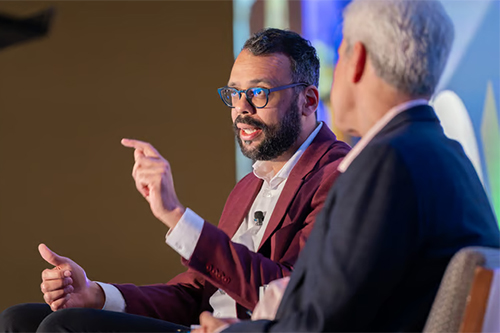
Photo courtesy of Heterodox Academy
During this year’s Open Inquiry Week, a number of campus groups participated in events designed to model and examine the conditions that make rigorous academic exchange possible. Among them was a Michigan-based group of Heterodox Academy members, which hosted a table at the event featuring economist Glenn Loury.
Heterodox Academy, often abbreviated as HxA, is a nonprofit organization founded in 2015 by social psychologist Jonathan Haidt, along with Chris Martin and Nicholas Rosenkranz. It began as a small network of scholars concerned that a lack of viewpoint diversity within certain academic fields was narrowing the scope of inquiry and, in turn, affecting the quality of research. Jonathan Haidt and his collaborators initially connected through conversations in social psychology and law about ideological uniformity in their disciplines; what started as a blog and informal exchange quickly developed into a broader academic community.
Today, HxA describes its mission in terms familiar to many universities: advancing open inquiry, viewpoint diversity, and constructive disagreement as conditions for strong scholarship. The organization has grown from a few dozen founding participants to a global membership numbering in the thousands, including faculty, staff, and students across disciplines and institutions.
Since the beginning, HxA has been at pains to articulate that, as a critic of ideological monoculturalism, it is not a partisan organization almost by definition. This has been an uphill battle. After all, campuses are already home to a great diversity of viewpoints, say HxA critics, so what does this phrase actually mean if it’s not, in fact, referring to political affiliation?
On its own terms, HxA emphasizes that it is not aligned with a particular political ideology. Its membership, the organization states, spans the political spectrum and is “united by a shared commitment” to core academic principles: open inquiry, viewpoint diversity, and constructive disagreement. Those commitments are framed not as ends in themselves, but as mechanisms for improving the research, teaching, and institutional decision-making already taking place at every academic institution.
At the same time, HxA’s work has drawn a range of interpretations in public and academic discourse. Supporters often see it as a corrective to intellectual homogeneity in some fields, while critics have argued that its framing of campus climate can overstate the extent or nature of viewpoint suppression. That range of perspectives forms part of the broader national conversation about academic freedom, institutional neutrality, and the role of universities in public life.
Within that context, local campus communities have emerged at universities across the country, including at the University of Michigan. These campus-based groups operate independently, organizing discussions, events, and informal networks for faculty and graduate students interested in questions of academic culture and discourse.
The presence of HxA at Open Inquiry Week reflects an area of overlap rather than institutional alignment. The university’s current emphasis on dialogue, free expression, and constructive engagement across difference has drawn participation from a wide range of groups and perspectives. HxA’s framework – whatever one’s view of its claims – centers on many of the same underlying questions: how universities sustain environments where disagreement is generative, and where intellectual risk remains compatible with scholarly rigor.
“Good classroom practice, at least in the empirical sciences, treats disagreement as part of the method, not as antagonistic to it,” said Fred Feinberg, Joseph Handleman Professor of Marketing in the Ross School of Business and professor of statistics in LSA. Feinberg serves as a co-chair of the U-M HxA Campus Community.
“A worthwhile discussion – among students, faculty, or anyone else – should urge us to make our assumptions explicit, confront evidence and arguments that might weaken our own, and understand why a reasonable person might come to very difficult conclusions. One of the goals of Heterodox Academy is simply to encourage ‘well-meaning disagreement’ and engagement among people open to updating their positions, all without The Sound and The Fury that such discussions can often lead to.”
As universities across the country continue to grapple with questions about expression, disagreement, and institutional voice, organizations like Heterodox Academy remain part of the evolving landscape. Their presence on campus, whether through formal events or informal networks, offers one vantage point on a set of issues that extend well beyond any single group.