

Catching Up: Talking Maize & Blue
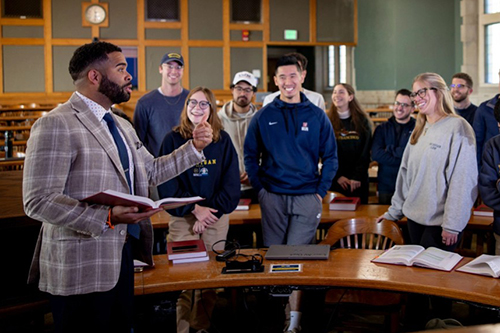
Photo courtesy of the Office of the Vice President for Communications
Several months following its launch, the Talking Maize & Blue initiative has reached thousands of students, and the team behind it is already reimagining the experience for the 2026-27 academic year.
Talking Maize & Blue began with a straightforward, yet ambitious goal of providing every incoming student a shared foundation for open inquiry and civil discourse. Its required online module for first-year students introduced the “Michigan PAUSE” framework (Pause, Appreciate, Understand, Share, Explore) as a practical tool for engaging with challenging ideas. The module asked students to weigh in on questions ranging from the lighthearted (“Does pineapple belong on pizza?”) to the genuinely contested (“Should hate speech be censored?”) and invited them to watch video responses from peers across the ideological spectrum.
The experience was designed to demonstrate that disagreement is a rich intellectual territory to be cultivated rather than a problem to be solved. It also helped kick off multiple touchpoints throughout the year including culture-building events like Open Inquiry Week and materials to aid U-M communities in putting its ideals into practice.
In Development
As one element of Talking Maize & Blue, the online module is being refined based on usage data and feedback from the 9,890 students invited to participate, with several meaningful improvements planned for fall 2026.
The section on how the university supports open inquiry is being redesigned around a scenario-based format: students will be asked how they think the university handles a given situation before learning how it actually does. The shift is a nod to learning science, where generating an answer before receiving it produces deeper understanding than passive reception alone.
The Michigan PAUSE section is also getting an upgrade. Rather than describing the framework in text, the new version will include video footage of students actually working through PAUSE exercises. The idea is to show rather than tell, giving students a concrete model of what productive disagreement looks like in practice.
“Each iteration of Talking Maize & Blue is an opportunity to get closer to what we know is effective,” said Paul Resnick, professor of information and chair of the Talking Maize & Blue task force. “The research on learning is clear: the more students have to generate and experience, rather than simply receive, the more likely they are to actually carry these skills with them.”
Perhaps the most significant addition is an opportunity for students to experience open inquiry in real time. Through a partnership with an external platform called Sway, students will have the option to engage in a live online chat with a peer who holds a different opinion. The progression — from hearing about disagreement, to watching it, to practicing it — tracks a deliberate pedagogical arc that moves students from concept to experience.
Taking the Conversation Off-screen
One of the initiative’s more creative recent experiments happened in collaboration with Michigan Dining. In April, the Talking Maize & Blue team piloted The Campus Take, a daily question platform accessible via QR codes placed in napkin holders across dining facilities. Using the same quiz mechanics as the main module, The Campus Take brought open inquiry into an unexpected everyday setting.
The pilot was well-received enough that the team plans to bring it back in the fall, and the collaboration with Michigan Dining demonstrates a broader ambition to extend Talking Maize & Blue beyond orientation into the rhythm of campus life.
“We want open inquiry to feel like something U-M does, rather than something we require,” said Vice Provost for Undergraduate Education Angela Dillard, who convened the Provost-charged task force that created the original version of the app-based course. “The Campus Take pilot is only one example of what our commitment to dialogue and constructive disagreement looks like in day-to-day practice.”
Zooming Out
Talking Maize & Blue fits within a larger dedication to pluralism at U-M: one that includes the campus-based Dialogue Michigan, the university’s new campus-wide initiative for constructive engagement, as well as an investment in a permanent and public-facing Center for American Dialogue. Together, the efforts represent Michigan’s answer to a pressing challenge within higher education: how best to prepare students to tolerate difference while also learning from it.
More details on the 2026 module and expanded on-campus programming will be available as the fall semester approaches. Faculty and staff interested in incorporating open inquiry into their courses or units can learn more at the Life-Changing Education website.